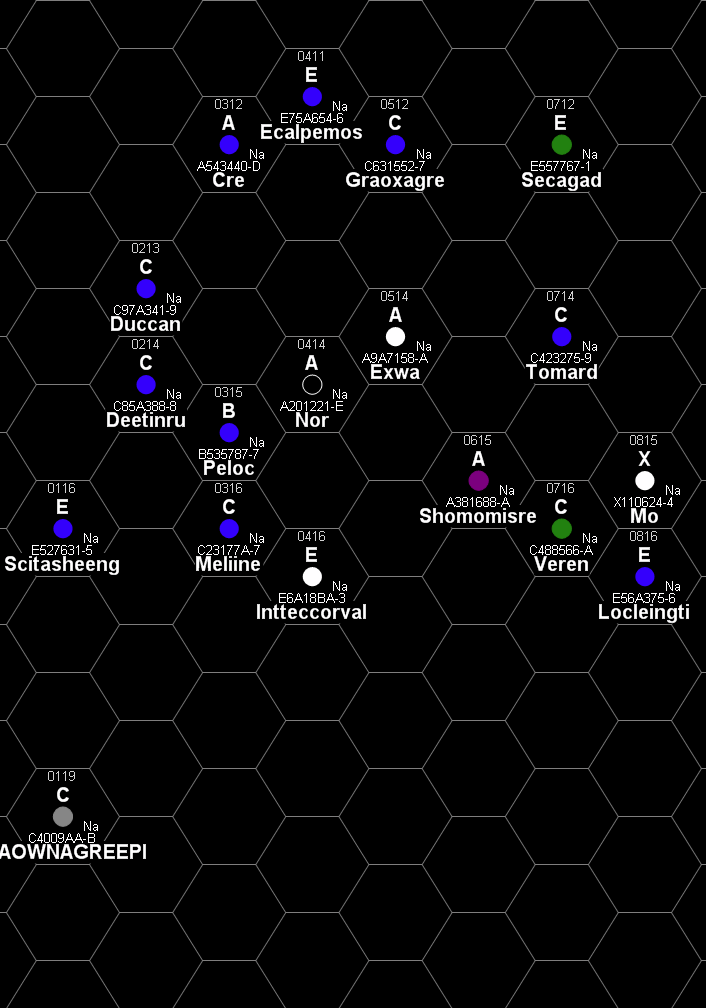
I found a new subsector at Traveller Map. I am sure it wasn’t there a few days ago. Now we can have a look at subsector E of Pliabriebl sector. There was no news about it at the Traveller Map blog (yet). If you look at the credits for this Sector, you can see that it is Marc Miller that has mapped this subsector.
The reason for mapping this subsector must be that in the very successful Kickstarter project for Traveller5 you will get your name “laser-carved on the alabaster cliffs overlooking the Sea of Mists on Ecalpemos (Pliabriebl 0411) after the crucial Battle of Shadows against the Black Fleets” if you invest $25 or more. I am also looking forward to reading more about the Shadows and the Black Fleets as well…
Subsector E of Pliabriebl sector – Created using post function at Traveller Map.
The Fat Cat (tIG TPT-133 “Fat Cat” Logistics Transport) is an interesting ship from Fat Cat Games. It’s a 300 ton trader with an unorthodox design. 300 tons might be a nice compromise between the 200 ton far trader, that might seem too small and the 400 ton Subsidized Merchant that may be too big. This feels like it would be a perfect adventure ship. The design is done for Mongoose Traveller rules, but can easily be used with any Traveller rules. The design is for an unspecified ATU (that I think we will soon hear some more about), but can easily be used in the OTU.
tIG TPT-133 “Fat Cat” Logistics Transport From DB Game Design
The deckplans in the book are in black and white. The level of detail in them are better than what we are used to see in a CT product. The side views are really cool. I like that they have included images of humans to show the size. The descriptions of the deckplans are very good.
Side View of Fat Cat
The CGI images are good but I think the texture on the ship is a bit boring. (I want to see serial numbers, name of the ship, company logo, warning markings, etc.) The darker images are the ones I like the best. The mirror effect on the landed ship is quite cool, since that is not what we are used to see. Showing humans with the landed craft is also a good idea.
Fat Cat in Space
In the last part of the book there is an example crew and 3 Patrons (adventure hooks). I like this, since I like adventure. Now it is easy to use the ship, either as an encounter or as a PCs ship to run some quick scenarios.
I like this product. It could serve as a template for what a product for a Traveller Starship should include. (I only missed a good index.)
You can get this now as a pdf at DriveThruRPG, but there is also a Kickstarter project for a printed (and updated) version. At the Kickstarter site, there is also a nice picture of the ship landed in water.
Another quick competition. A $10 prize at DriveThruRPG for the winner.
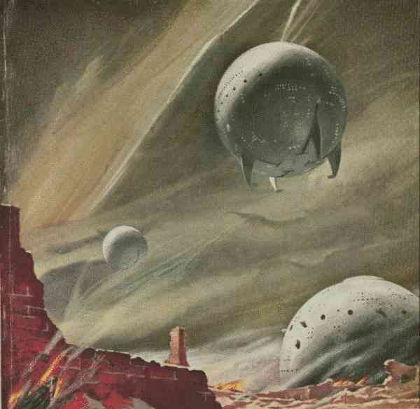
Design a medium-sized Spherical Ship using any Traveller rules. It doesn’t have to be a Mercenary Cruiser. You may assume that it can land and take-off (but not fly) in a standard atmosphere. You may add write-ups for crew, deck-plans and any other stuff you like. Name you design after anything Swedish. (Have a look at the ship names of the Swedish navy at Wikipedia.)
Coolest design will win $10 at DriveThruRPG. Send Your entries by e-mail. Please use plain text format and attach any images. Word files will not be accepted! Send in your designs before the 5:th of June. The designs will be published at the Zhodani Base on the National Day of Sweden.
The competition starts now and ends 5 June 2012.
By entering the contest You allow your entry to be posted at the Zhodani Base. All entries might also be posted in PDF format as a free down-loadable file at the Zhodani Base.
What has Mongoose done to the Sword Worlds? Do I need this book? These are the questions that I will try to answer here.
The cover of the book is quite cool, but it doesn’t look like the soldiers in the image are Sword Worlders at all. 😐
Interior art is not bad either. I just feel it is too much Viking themed, and not really showing the hi-tec spacefaring culture that I wanted to see. The deckplans are fine and the 3D rendering of the Jarl is ok. It can be seen in colour at Biomass Art.
There are a few contradictions in the introduction of the book. Are the Sword Worlds a dangerous place or a popular place to visit? Are there no physical differences from original Solomani or is the average male weight 105 kg, and the females pregnant for 10 months? Then there is also (a likely) bug in the naming rules, since the female surname possessive form is missing, but not the male possessive form.
How did they come up with the Army Ranking table? I don’t think that matches any Scandinavian army. (SWE, NOR, DEN)
There are 3 new careers. The first one is the Aesirist Church. This isn’t something that I like. It is too Viking themed. I will not use it in MTU. The next one is The Patrol. From old JTAS #18. This is a good idea to include. The third is Jäger Command. I think it should really be part of Marines or Army, as special forces.
The origin of sagamaal and the vocabulary makes some sense. Currency and exchange rate was a good thing to include. History is a bit messed up. It’s interesting but doesn’t match the previous publications.
In the Worlds chapter, the world listing of the subsector is missing the worlds outside the Sword Worlds. The atmosphere of Enos is explained in the same way as in the GURPS SW module. (To keep Traveller fun, these things should be ignored so that the referee can deal with in a different way.) Mithril matches the old adventure Mission on Mithril.
The equipment list is nice, but there are some items that are just too Viking themed. There are a nice selection of ships. Some parts of the encounter tables are fine, and the animals are interesting. The miniphants has been changed. They are not the same miniphants as in JTAS #16.
There are some proofreading errors (as usual). There are some extra-large apostrophes. There is a reference to a class III starport. (That is what a type C starport is called in GURPS.) There are some talk about the Border Worlds (that shouldn’t exist in 1105). I get an error message in the end of the pdf. Please Mongoose, do a better job!
So, I think that parts of the book is good, and other parts are not so good. You can buy it for the good parts. Maybe you like the other parts as well. The alternative would be to use JTAS #18 and read Space Viking for free, and form your own opinion about the Sword Worlds.
A problem with the random generation of worlds in Traveller is that for small worlds (where size < 4) is that these worlds might get an ordinary breathable atmosphere. This is a problem, since the minimum molecular weight retained for a planet shouldn’t allow that. EDG has explained minimum molecular weight retained here, and here is a nice visual tool for checking what gases will be retained depending on size, density and temperature.
This problem leads to silly explanations. Like the one in both the GURPS and Mongoose Sword Worlds modules where a planet (Enos) is made of Osmium. Other explanations might be terraforming by the ancients.
These silly explanations might explain how a few (very unique) worlds got their atmospheres. But it seems unlikely that these explanations can explain every world equal or smaller than size 3 with an atmosphere equal or greater than 2. In an average sector with standard stellar density there are about 80 such worlds. (In the Spinward Marches, there are 73 worlds with this problem.)
I usually ignore this problem, since our group of Traveller players don’t care about details like this. They want to play the game. But if the question is asked, I now have a solution. Instead of explaining every world or changing the UWP, I use this table.
SIZE
DIAMETER miles
DIAMETER km
1
4000
6400
2
4500
7200
3
5000
8000
4
5500
8800
5
6000
9600
6
6500
10400
7
7000
11200
8
8000
12800
9
9000
14400
A
10000
16000
As can be seen is this table, the problem is solved by making the smallest planets big enough to retain a breathable atmosphere. (The original table can be seen at Traveller Map.)
Terraformed Mars: File from wikimedia. Licensed under the Creative Commons Attribution-Share Alike 3.0 Unported license.